Learn how to manage your translation files, work with localized strings and create localized routes.
Laravel's localization features provide a way to work with localized strings but with some extra code, you can convert your application into a real multilanguage app.
Installation
As a Laravel user, we'll assume you already have a Laravel application, or you created a new one. You can follow the more suitable method from the official documentation or the recent Laravel Bootcamp.
Language files
Language files are stored within the lang directory. Laravel provides two ways to organize your translations.
First, language strings stored in .php files in a directory for each language supported by the application.
/lang
    /en
        messages.php
    /es
        messages.php
With this method, you should define your translation string using short keys like messages.welcome inside a PHP file:
<?php

// lang/en/messages.php

return [
    'welcome' => 'Welcome to our application!',
];
Or, translation strings stored in JSON files that are placed within the lang directory. Each language supported by your application should have a corresponding JSON file within the lang directory.
/lang
    en.json
    es.json
With this method, the key is used also as a translation for the default locale. For example, if your application has a Spanish translation and English as a default locale, you should create a lang/es.json file:
{
    "I love programming.": "Me encanta programar."
}
You should decide which method is the most suitable for your project depending on your translation strings volume and organization.
While the official docs conclude that JSON files are better for applications with a larger number of translatable strings, we've found that this is not always true, and it depends on your application or team.
Our advice is to try and investigate which method works best for your application.
Using translation strings
You may retrieve your string using the __ helper function. Depending on the translation string strategy you choose, you should refer to your translation string in a different way:
- For short keys (PHP array files): you should use the dot syntax. For example, to retrieve the
welcomestring from thelang/en/messages.php, you should use__('messages.welcome') - For default translation string keys (JSON files): you should pass the default translation in the default language to the
__function. For example,__('I love programming.')
In both cases, if the translation exists does not exist, the __ function will return the translation string key.
Starting here, we'll use the short keys syntax for our examples, but you can use what works best for your application.
Configuring Laravel locales
Default and fallback locales for Laravel are configured in the config/app.php configuration file:
/*
|--------------------------------------------------------------------------
| Application Locale Configuration
|--------------------------------------------------------------------------
|
| The application locale determines the default locale that will be used
| by the translation service provider. You are free to set this value
| to any of the locales which will be supported by the application.
|
*/

'locale' => 'en',

/*
|--------------------------------------------------------------------------
| Application Fallback Locale
|--------------------------------------------------------------------------
|
| The fallback locale determines the locale to use when the current one
| is not available. You may change the value to correspond to any of
| the language folders that are provided through your application.
|
*/

'fallback_locale' => 'en',
But we also want to define other available locales apart from the default one. We can do that by modifying this configuration file and adding a new available_locales key after your existing locale key:
'locale' => 'en',

'available_locales' => [
	'en' => 'English',
	'pt' => 'Português',
	'de' => 'Deutsch',
],
Redirect and switch locales
There are lots of different ways to set the application locale for every request on your application, but in this article, we'll create a Middleware to detect the route locale and set the application language.
Creating the middleware
You can create the Middleware using the make:middleware Artisan command:
php artisan make:middleware Localized
We want to register this Middleware in order to be able to use it in our routes files, so we should add it in the app/Http/Kernel.php file. We need to add it on the application's route middlewares:
/**
 * The application's route middleware.
 *
 * These middleware may be assigned to groups or used individually.
 *
 * @var array<string, class-string|string>
 */
protected $routeMiddleware = [
    // ... other middlewares
    'localized' => \App\Http\Middleware\Localized::class,
];
And finally, we can add the localization features to our middleware:
<?php

namespace App\Http\Middleware;

use Closure;
use Illuminate\Http\Request;

class Localized
{
    /**
     * Handle an incoming request.
     *
     * @param  \Illuminate\Http\Request  $request
     * @param  \Closure(\Illuminate\Http\Request): (\Illuminate\Http\Response|\Illuminate\Http\RedirectResponse)  $next
     * @return \Illuminate\Http\Response|\Illuminate\Http\RedirectResponse
     */
    public function handle(Request $request, Closure $next)
    {
        if (! $routeLocale = $request->route()->parameter('locale')) {
            return redirect($this->localizedUrl($request->path()));
        }

        if (! in_array($routeLocale, array_keys(config('app.available_locales')))) {
            return redirect($this->localizedUrl($request->path()));
        }

        $request->session()->put('locale', $routeLocale);
        app()->setLocale($routeLocale);

        return $next($request);
    }

    private function localizedUrl(string $path, ?string $locale = null) : string
    {
        /**
         * Get the default locale if it's not defined
         */
        if (! $locale and request()->session()->has('locale')) {
            $locale = request()->session()->get('locale');
        }

        return url(trim($locale . '/' . $path, '/'));
    }
}
Adding locale to routes
Modify your routes/web.php file to add the locale prefix and the redirection middleware:
<?php

use Illuminate\Support\Facades\Route;

/**
 * Localized routes
 */
Route::prefix('{locale?}')
    ->middleware('localized')
    ->group(function() {
        Route::get('/', function () {
            return view('welcome');
        });
    });

/**
 * Other non-localized routes
 */
Switching locale
At this point, you can simply add your locale prefix to your URL, and the middleware will set your application language. For example, /pt will set the application locale to Portuguese. Also, if you open any localized route without a locale prefix, the user will be redirected to the last used locale stored in the session.
Finally, you can loop over the available locales to create a localized navigation:
<nav>
    @foreach(config('app.available_locales') as $locale => $language)
        <a href="{{ url($locale) }}">{{ $language }}</a>
    @endforeach
</nav>
Keep in mind that this is a really simple example. A final version should generate localized links for the current URL on each request.
Parameters
When retrieving translation strings, you may wish to replace placeholders with custom parameters. In this case, you should define a placeholder with a : prefix. For example, you may define a welcome message with a placeholder name:
'welcome' => 'Welcome, :name',
And then retrieve the translation string passing an array of replacements as the second argument:
__('messages.welcome', ['name' => 'Joan']);
You can also modify your placeholder to capitalize the replacement in this way:
'welcome' => 'Welcome, :NAME', // Welcome, JOAN
'goodbye' => 'Goodbye, :Name', // Goodbye, Joan
This is especially useful when a language needs to place the placeholder at the start of the string and another in the middle of it:
'accepted' => 'The :attribute must be accepted.', // English
'accepted' => ':Attribute moet geaccepteerd zijn.', // Dutch
Make it easier with Locale
As a developer, after working on internationalization for your application, you may be involved also in the localization process with translators and your team. That could be a long process and a good reason to choose a translation management tool like Locale.
With Locale, your team and translators will be able to enjoy a next-level localization workflow built for productivity.
Get started for free now and level up your workflow.
You can learn how simple the configuration process is by following our 4-step guide.
And, if you are a visual learner and prefer to watch the process, we've recorded a step-by-step video showing how easy it is.
Most people believe it is necessary to obtain information about a particular product or company in their native language, even more than the price of the product itself. Before proceeding with the localization of software or a website, it is necessary to understand the target market and know the audience that will hopefully benefit from the software or product you want to sell.
Localization plays an essential role in enhancing your business sales. With tools like Locale, you can translate and localize your website to meet the needs of your intended target. In this article, we will look at how localization can improve your business sales.
Builds trust
Content localization is a reliable marketing mechanism. It makes it possible to reach a target audience in their mother tongue by eliciting the same emotional reaction as locally created content. This effect leads to greater trust and improved customer acquisition and retention.
Relationships with consumers and customers are built on emotional attachments that evoke feelings of trust, reliability, interest, and positivity. Any content related to a product or service should be designed to elicit exactly those feelings in the target audience.
Content that is simply translated but not adapted to cultural preferences, regional customs, local formatting standards, and other aspects can have a detrimental effect on sales and customer relations.
For this reason, translated but poorly localized content in marketing can contribute to increased churn rates and decreased sales. Localizing the content helps prevent this from happening. The trust built plays a crucial role in your conversion rates. Our Laravel i18n localization tool provides the best features and solutions to boost your business sales.
Creates a perfect content marketing strategy
Without localization, your content marketing strategy can be doomed. Including content localization in a marketing strategy brings you significant benefits, which influence brand recognition and exposure:
- Stand out from competition
- Make sure the target audience understands the message
- Maintain the interest of the target audience
Convert leads into customers
An intelligible and emotionally engaging website has excellent conversion power. Your potential clients will have a clear understanding of the products or services you are offering and make the right buying decisions. Customers are more likely to cooperate with a brand they understand, which gives them the feeling of being able to understand them in return.
Facilitate introduction in any market
Adaptation to an audience is facilitated by considering the different cultural factors that form the identity of individuals and groups. Localization will introduce your business to new markets where you will win new customers and increase your sales. Your localized website will also rank high in various search engines and provide customers from different markets with unique products or services you are offering.
Makes your business accessible to a global audience
Making your site or software accessible to a foreign audience denotes the desire for the customer to understand all the advantages of a product fully or how to best use a software. Customers feel they understand which product or service they could purchase more important than when it will cost them. The customer, therefore, understands that your site represents a serious, transparent, and clear company, able to explain and advertise what it has to offer well. This can help increase your conversion rates.
Once you have attracted the customer with something he can read for himself and after having clearly explained to him, in his language, that the product or service you offer is right for him, then the conversion will take place: the customer will contact you to purchase your service or product. A well-localized site will allow you to conquer a new market and consequently increase your turnover.
How to create the best localization strategy?
Find out now how you can create a good strategy for successful localization.
1. What language do your potential clients speak?
Your clients may come from different countries and speak different languages. So choosing the language set for content localization can be quite tedious. This choice will depend on the following points:
- The predominant language your followers speak
- Your overall marketing strategy that will help your business grow in foreign markets
Balancing these two aspects ensures an optimized localization strategy. So how do you estimate the percentage of predominant languages your followers speak? You can use the built-in social analytics tools that all social media have. The numbers are updated there in real time, which also allows you to track the progress and engagement rates of your new target audience after you implement your localization strategy.
2. Collaborate with virtual assistants
We can't stress this enough, but working with virtual assistants is key to successful content localization while focusing on your core business. As content localization needs cultural and practical adaptation, here are some essential points requiring the intervention of a virtual assistant:
- A virtual assistant for the research you need on the region, country, or group of people you are targeting
- A translator
- A proofreader who will make reading in the target language more fluid
It would be ingenious to find a local translator or a local proofreader so that your content is well understood by the target buyer segment. It is also important to check your writing using editing and proofreading tools such as Grammarly.
3. Create different social media profiles for localized content
When creating a content localization strategy, it is best to create separate social media profiles where you will post localized content so your content strategy won't look too messy. However, it is practical to publish content in two languages if you need to target a certain foreign audience occasionally.
Many large companies already use this strategy. For example, IKEA has more than 10 Instagram accounts for each country in which it operates.
NB: Do not forget the localization of hashtags at the same time.
Locale offers a reliable solution to localize your website with its simple integration and seamless interface.
]]>For younger companies, going international is often the opportunity to prove the replicability of the model. In short, the motivations are diverse. But if you are entering a new market, there is always one golden rule to follow: speak to consumers in their language.
Nothing is as credible and reassuring for consumers as having a brand in front of them that understands their culture, speaks their language, and knows their problems. And it is also a convincing argument when it comes to making the purchase: 75% of consumers prefer to buy a product presented in their native language. This is why translation is one of the critical steps in your international expansion!
With the right translation tool, you can localize your business and reach a particular audience in a specific region. The Laravel localization tool is one of the best web localization tools in the market. With a simple installation option and seamless interface, your team will have an easy time. This article gives you 5 tips for the best Laravel translation.
1. Identify Your Audience Accurately
Who do you want to contact? What is the typology of your prospects in this market? What are their problems, and what solutions can you bring to them? To answer these questions, you must do some groundwork: developing personas.
Thus, you determine your priority targets in the new market and therefore determine which content to have translated. There is no question of having your entire website translated, nor all your white papers and customer cases. You must prioritize! Personas help you identify which translations are necessary or urgent to offer your target only content that corresponds to them and interests them.
For example, imagine that you are an e-merchant specializing in sports accessories. You have a company blog on which you publish articles about sports news and major events. Be careful to think carefully about the interest of your readers in each market, and not to have all your articles translated without thinking! Ice hockey competitions are of great interest to Canadians, but not so many South Americans… just as pétanque is not the favorite sport in England.
2. Prepare a good translation brief
You can't make an omelet without breaking eggs!
- To obtain quality and relevant translations for your target audience, start by writing a complete brief
- What keywords do you want to rank for?
- What tone do you want to use in your marketing content?
- Should the vocabulary be sober, familiar, or sustained?
- Do you want to address your interlocutors as familiar or as you?
- Do you prefer rather long or short sentences?
Before having your site translated, ask yourself all these questions to share these details with the professionals in charge of translating your Marketing content.
From the SEO point of view (whether natural or paid), many companies do not know the considerable advantages of a good translation. Be aware that translating your keywords from the source language to the target language is not enough, if not ineffective.
A well-thought-out international SEO strategy requires the complete localization of your keywords and your marketing content, particularly those on your company's website.
3. Work With Native Professionals
Despite the undeniable progress of machine translation engines in recent years, translation remains a human profession. Only a human translator, and a native one, knows his language's subtleties and can transcribe your brand's essence into the target language.
Multiple online translation services give you access to large networks of native and professional translators, handpicked and rigorously tested. It is also important to choose translators comfortable in your field.
Very often, content must not only be translated but at least localized (i.e., adapted to the target and the market's culture) or even "transcreated" within the framework of an advertising slogan or a marketing pitch. A native translator knows how to optimize the translation of your Marketing content to:
- Position yourself as an expert in your field of activity;
- Win the trust of your target in your new market;
- And ultimately convince consumers to choose your brand.
Our Laravel localization tool has features like enhanced communication for smooth teamwork during your Laravel translation.
4. Be Brief
Languages are complex, have different sentence structures, follow different rules, and use different sets of words to express an idea.
Minimize comprehension problems in the translation by formulating the source text briefly and concisely (form active clauses, no stringing together of nouns, orientate yourself), do not form long, convoluted sentences, and do not use synonyms or use the same concept.
The use of synonyms, in particular, is an often underestimated and costly source of translation errors, which multiplies with each additional language to be localized. You should, therefore, consistently use the same choice of words in the source text and never use two different names for the same term. Ideally, you introduce an appropriate word list or consistent terminology management immediately.
5. Test the Suitability Of Your Files For Translation
First, check if your files are suitable for translation. Even in the source text, the source code and structure should be designed so that possible sources of error are identified in advance. This also includes avoiding or reducing hard-coded text to a minimum since language follows different grammar rules, which sometimes produces errors with localized strings.
The easiest and quickest way to identify localization problems in advance is to test with your localization partner using a pseudo localization ("dummy translation") whether the files can be translated with the common tools and then be played out correctly so that you can import them again. Display or functional errors, for example, and over- or under-translation, can be detected and corrected in this way.
As a final note, we would like to mention an article we wrote with 10 additional tips for optimizing your Laravel localization and translation workflow. We are confident it will be helpful to you.
]]>Suppose the information on your company website is presented in only one language. In that case, your business loses a huge share of the opportunities to provide service or sell goods to customers from other countries. At the same time, you give your competitors an extensive list of advantages, which, in turn, will allow them to increase their presence in the international market in the future.
Let's get to the heart of the matter. If you are planning to sell not only on the local market but strive to enter the international market, web localization cannot be called just an addition. At present, this is already a necessity. Locale offers one of the best and easy-to-use web localization options: the Laravel Localization Tool. This can help grow your business to unimaginable levels because you will be able to reach the international market.
Web localization offers multiple benefits to your business. We will look at this in detail.
A Few Facts about the Language Picture of Sales
It is worth noting that now clients abroad tend to seek information not in English but in their native language. For one reason or another, sites that cannot provide the necessary information have a low session duration and, as a result, low attendance in the future. Analyzing the data of various studies, we can conclude the following:
- The time when English was the dominant language of search on the global Internet is beginning to fade away. If we analyze the datasets of SERPs, we find that approximately only 24% of the SERPs are in English, while the remaining 76% of queries are in other languages.
- China and India are starting to take over the Internet. As of January 2022, China had over 1.02 billion internet users, while India had approximately 850 million. Let's pay attention to the fact that none of the users in this group use English when searching as the main language.
- Global shopping is more focused on selling worldwide through apps. Approximately half of the online shoppers use a smartphone and apps to shop. In addition, they prefer to read the information there in their native language rather than in English. A similar outcome is expected in the service sector in the foreseeable future.
Trends like these are direct proof that if your business speaks different languages, your customer base will surely grow.
Localization for Business Growth
Web localization plays a pivotal role in the growth of your business.
Localization is a powerful tool for establishing contact with customers
So why is a well-executed website localization so important? For start-ups, it can become both an obstacle and help for further development.
Let's take an example: imagine that your company advertises its product in Britain, Ireland, Australia, and USA. Despite the differences in English language versions for these countries, a well-tuned advertising campaign should generally bring a positive result.
However, suppose we try to launch a similar campaign in Germany, Poland, the Czech Republic, and France. In that case, you will no longer achieve the desired conversion since users from these countries prefer to search for information in their native language. In this regard, to ensure high conversion, both the advertising campaign and the information on the site must be in the appropriate language for these countries.
At this point, we think it is mandatory for us to share another article we wrote on growth and the importance of localization for your business.
Advantages of Localization from a Technical Point of View
-
Increasing the level of confidence on the part of potential customers. If the site can "speak" with the client in his language, he is already more attractive than competitors.
-
Increasing the level of interaction with your business. High-quality localization eliminates the risk of misinterpreting your resource information by the target audience.
-
Growth of audience coverage. As a rule, sites on which content is presented in several languages have a sizeable semantic core. Thus, the audience coverage will be noticeably wider due to the large number of search queries leading to the resource.
It is worth adding that to implement high-quality localization of your company; you need to find a contractor who will not make a mechanical word-for-word translation of the content but will recreate it using another language, taking into account the thinking and cultural aspects of the target audience. The laravel localization tool can give your business a competitive edge and help you grow.
How to Choose the Right Web Localization Experts
Relying on localization experts or tools is vital for quality translations tailored to the needs and culture of your target audience in a specific country. Consider the following when hiring a localization expert.
The delivery time
The delivery time is an essential factor for both the client and the agency. Choose an available service provider who can deliver your translation promptly. Do not hesitate to notify your service provider in advance if you have an urgent need. He can then organize himself and offer you a delivery time that you can refuse or not.
The speed of a translation should not compromise the quality of a project. It is therefore essential to leave reasonable leeway to your web localization agency. The priority is to obtain high-quality service.
Expertise
Web localization must be done by professionals specialized in your sector of activity. This is, for example, the case of law or medicine. To obtain a reliable and high-quality service, entrust your project to a specialized agency with real expertise in your business.
The Cost
The cost of web localization is essential, but perhaps not in the way you imagined. Indeed, all work deserves pay. To request a quote from a service provider, be as specific as possible about your project. Then communicate the number of words, the budget, and deadline constraints related to your project. When you receive a quote that is too attractive, beware! Remember that you are looking for a real professional. The best affordable alternative would be getting the laravel localization tool (i18n) which is super effective and easy to use.
Meta Description
Web localization can go a long way in ensuring your business grows and you reach the international market. The laravel web localization tool is one of the best options for your business.
]]>As a business, you are likely to miss out on many customers if this is the case. The best solution to this is web localization. Localization is not all about translating your site into a language your target market understands. There are several practices that come into play to ensure everything is successful. Every website component should adapt to the needs of the customer base in the market you intend to conquer. In this article, we will look at the best web localization practices you should follow for the best results.
Why localize your website?
Websites have become important assets to attract new clients because of the growing number of online users. Selling items or offering services to customers across the globe requires one to use the best approach. We live in a world of diverse cultures and languages, so you should develop strategies unique for each market. Web localization is one of the best strategies to reach a broader audience in various markets. Most people also use search engines in their local languages. Localization makes it easy for them to find you because your site will be in a language they understand better.
Hire translation experts
You shouldn't make web localization a complicated process. Always make sure that your content is in a language or format your target countries prefer. The best way to go about this is to hire translation management experts, who will handle everything from translation to website localization. They will take care of your website translation needs.
Don’t forget multilingual SEO
Understanding your audience is essential for website localization. Getting to know the real people who need your products or services will help you take the right search engine optimization measures. You will easily pick the right keywords for your target market in various regions or languages and pull more organic traffic to your site. This practice is vital in ensuring your site is visible in various markets. With the right SEO strategy, especially with the choice of keywords, you will rank top of your competitors.
Work on your website display
Languages differ in length. Some are long, while others require fewer words. Translating a site into multiple languages will result in paragraphs that vary in length. This can impact your site appearance and page composition because of the number of text displayed on your screen. You should, therefore, pay attention to these changes after web localizations since they affect user experience. Make the necessary changes to the translated content while making the correct punctuation where required.
The design of your website should also be flexible and meet the evolving needs of various languages. Some of the things you should look out for include action buttons and icons because they are the primary cause of problems. The Laravel localization tool will ensure your site maintains the perfect structure after localization.
Regular testing
Web localization is a continuous process. Regular testing is essential to avoid errors, problems, and specific bugs. Understanding what works for you will help you come up with solutions that meet the needs of your visitors and offers them the best experience on your site. You should test new texts, identify the content your new customers love the most, and analyze your results every time.
Good customer service
You shouldn't neglect your customers and make sure you provide solutions and answer them in a language they understand. Some of the avenues you should take advantage of include live chat, social networks, contact forms, and telephone lines. If possible, utilize automatic translation tools that are super accurate to offer the correct answers fast.
Create a global user experience
Website localization goes in handy with a user experience that meets the needs of specific cultures or languages. Several errors in the translation process can affect your project. Some of the things you should pay attention to include:
- The visual elements of your site like colors, site structure, and images
- Perfectly optimized layout and menus
- Proper sentence structure and paragraphs
Our Laravel i18n localization tool also helps create the best user experience for your audience. You should carry out web localization with care to create the best user experience for audiences in multiple countries. Make sure the media used on your website meets the needs of audiences in the country you are targeting.
Don't skip important details
Most people tend to ignore some small details during website localization, affecting their visibility in the local market. Some of the essential details you shouldn't skip for effective web localization include:
- Time zone
- Currency
- Events Calendar
- Units of measurement and sizes
- Terms of delivery
- Payment methods
- Return and refund policies
Make sure these crucial details are adapted to the local market. Such information is always helpful for your visitors and can play a pivotal role in retaining and attracting new clients.
Provide the Option of Switching Languages
Some people who speak fluent English may prefer to access your site in their local language. You should allow visitors to switch to a language they prefer. This will help them understand your website and offer the best online experience. You are guaranteed more traffic in return.
Conclusion
Making your business open to new markets is always the best experience. Website localization lets you reach new buyers easily. You should always do your best to get everything right. Remember, website localization is not all about translating your site. You should create the perfect experience for local users in the markets you plan to conquer. Follow the best localization practices to know your audience better and what they expect. This will help you come up with the best experiences for users in different countries.
If you are translating Laravel projects, we recommend taking a look at Locale, one of the simplest and most effective workflows to localize Laravel applications.
]]>The challenge, though, is that localization is often viewed as a standalone operation that has no bearing on your business outside the scope of your website or app. Instead, localization should be embedded deeply within your overall business strategy and tied directly to your company's expansion goals. To effectively reach audiences in several areas, businesses must localize their communications by tailoring text, images, and audio to local tastes and customs. Use the best Laravel localization tool, Locale, to make your business global.
What Is Localization?
The term "localization" refers to the process of tailoring a product or service to the specific needs of a particular market, including the usage of that market's native language and cultural norms. As a result of the internet, previously inaccessible goods, services, and information are now available to people worldwide. From a corporate standpoint, this globalization of markets has brought both opportunities and challenges.
First, there has never been a better opportunity to launch your product in international markets. However, competing in local marketplaces by making your product or service stand out has grown more complex than ever. Consumers now want consistent, individualized service throughout their whole experience, regardless of where they are.
Therein lies the importance of localization. Localization goes beyond simple translation in its pursuit of making a product or service compatible with the customs and language of a particular market. Localization encompasses not just translating your material into the local language but also tailoring your user interface, transactions, pictures, formatting, and tech support to suit local tastes, norms, and customs.
What Are The Different Types Of Localization?
Web Localization
Your website is the very first interaction a potential client has with your business. If they click on it and find a foreign language, they are inclined to proceed. That's where web localization comes in.
It's even worse if you've translated the site but haven't localized it. A person with innate reading skills can typically discern the difference. To avoid these costly missteps, your organization should invest in web localization. A website needs more than simply text translation to be localized. The website's graphics must also adhere to the standards of communication and culture.
The tone of the website must also be suitable for its target audience. Moreover, localizing the website ought to account for cultural differences.
Software Localization
This method of localization is widely used for both apps and computer games. All physical parts must be replaced when localizing software.
This category includes the code's original form, pictures, the UI, and any accompanying written materials. To ensure success with this method, you'll need to design a user interface that can be translated into multiple languages.
This necessitates the availability of localization for all user-facing elements. This information is complete with prices, timestamps, and dates. To facilitate the localization process, saving the relevant information in a location apart from the source codes is helpful. That way, adapting the external codes to the necessary languages will be less hassle.
App localization
Mobile app localization involves changing the app's design and features to be more appropriate for users in specific regions or countries. Laravel's internationalization (i18n) effort continues with app localization. Using Laravel i18n, you can localize your project to work correctly for users of many languages and cultural backgrounds.
When it comes to localizing mobile apps, mere translation isn't enough. User interface (UI) elements, functionalities, in-app prose, visuals, and app store descriptions are all part of your app's assets that can be localized to meet the needs of users from various cultural backgrounds.
Product Information Localization
This is the procedure when introducing a product to a new market. All of the product information must be translated for this to work.
Information on the product's contents, manuals, and technical assistance are included. All information a customer could need to make an informed purchase decision should be readily available. People are more inclined to purchase if they can easily understand the information offered about the goods.
Benefits of localization
Reach a larger audience
You can increase your brand's visibility and credibility in international markets by having your products localized for those regions. This will also facilitate your expansion into those regions. Gain more consumers at the top of the funnel and assist leads in taking the next step in their purchase decision with your aid.
Converting prospects into paying customers requires establishing credibility. Building credibility with new customers requires tailoring your offerings and promotional efforts to the specifics of each area in which you operate.
Improve customer satisfaction
Maintaining satisfied consumers is essential once you've attracted them. An emphasis on the user experience is becoming crucial, especially if millennials make up a sizable portion of your client base. By localizing your content, blog posts, FAQs, electronic books, tutorials, reports, and customer assistance, you'll be well on ensuring you're addressing each client's demands.
You should also remember that these happy consumers will spread the word about your business and its services. They will talk about you and post reviews. They will be the ones to build and maintain your community, and word-of-mouth from satisfied customers is the most effective kind of advertising.
Streamline your workflow
Effective localization relies greatly on coordinated team effort. The members of a localization team typically include a localization expert, a project manager, translators, and sometimes even some more localization experts. The number of employees you need is directly proportional to the complexity of your operation, but no matter how big or small your organization is, you'll still require high levels of cooperation among your employees and between different departments.
That's why localization must have a well-oiled workflow and management structure. In today's fast-paced environment, a localization infrastructure that can manage all phases of a project's life cycle must be efficient and automated. The term for this iterative, optimization-focused approach is "continuous localization," and several platforms are designed to support it.
Make your brand more relevant
When it comes down to it, your brand doesn't belong to you but your customers. It's a summation of their impressions of you as a whole. Speaking to them in their native tongue while respecting their cultural standards elicits a positive reaction. The answer lies in increased spending. Suggesting you to relatives and friends. Including you more heavily in their daily routines. There is no place where web localization doesn't help your brand.
Locale - All-In-One Cutting-Edge Laravel Localization Tool
Locale is the first dedicated platform for Laravel localization. You and your translators can take advantage of a highly efficient Laravel localization procedure with the help of this application. An innovative invite system and a robust permissions manager will make it easy to collaborate with any group, whether they're located in-house or elsewhere. Go global with Locale!
]]>Locale is a platform and web application that facilitates the localization of Laravel projects through a cloud panel that enables your team a visual control of the translations, easy and fast synchronization and collaborative tools. Making the localization and translation experience more agile, enjoyable and powerful.
Step-by-step setup video
Prefer written instructions for setting up Locale?
If you need an in-depth guide covering the configuration of a Locale project, consider taking a look at the article "How to localize a Laravel application" we have written for you.
Early bird plan available!
🎁 Get started now and unlock an exclusive, grandfathered plan for early adopters.
]]>Even the total translation of a service or product information into just one target language is a complex undertaking. Managing translation projects with multiple target languages across several products can quickly become challenging.
Translation Management Tools or Systems (TMS) are software platforms that manage translation projects at scale. These tools develop a workflow that ranges from uploading the materials to be translated to reformatting finished translations. Locale, the Laravel Translation Management tool is one of the best options available in the market.
In this guide, we look at why a translation management tool is essential for your business.
Why Businesses Require A Translation Management Tool
The requirement accompanies the rapid globalization of the markets that content is available in several languages. In conjunction with the digitalization that is affecting more and more areas of life, companies often have to deal with an overwhelming number and variety of media and types of information - from practical authentication to marketing material. When you then multiply that diversity by 10 or several other languages can become a nightmare in project management.
On the other hand, if you use translation software that is an integral part of your international strategy, you can more easily cover multiple target languages across product and service boundaries. As a result, this means:
- Quick turnaround time
- Stronger international presence of your brand
- Increased global sales growth
It is imperative to emphasize the significance of localization for the expansion of a business. For a thorough examination of the topic, we recommend reading our article on the importance of localization for your business.
Reduced Time To Market
Translations can take a long time - significantly when service information and product volume are constantly growing. Any system that can speed up the localization and translation process compared to time-consuming manual editing directly impacts time-to-market.
Lately, there has been a trend towards stocking ready-to-ship products for which there is initially no translated documentation. The faster supply chains become, the more critical a more rapid translation process becomes - especially when opening up new markets. An integrated translation management system can provide valuable services here.
Improved International Brand Image
A brand's reputation depends very much on the perceived quality of its products, the user experience, and the buying experience with the service or product. A well-respected global company can address customers' cost concerns and present in a convincing way to new customers that they can expect a positive experience.
Translated material is usually the first thing a customer learns about a brand, its values, and the culture of its home market. The translation quality and the respect it conveys for the customer's culture, not forgetting the speed with which the company responds, play a significant role in opening up the market. A translation management system's review and quality control processes can provide substantial benefits in improving brand awareness and acceptance.
Improved Growth Of Global Revenue
Sales are directly linked to a brand's reputation and time. Establishing a new product in a particular area quickly will help boost growth rates internationally. The quality control mechanisms above can also help ensure those good reputation products are preferred – even at higher costs. With a TMS, a company can increase its ability to handle a more significant number of translation projects in parallel without sacrificing quality, which directly translates to an improved cash flow.
The Benefits Of A Translation Tool
The absence of an incorporated system means you may need to control your translation teams via spreadsheets, email, or chat tools. If you want to use technologies and stores, they have to be set up and maintained manually. Such provisional solutions may be suitable for simple translation processes with a few target languages.
But once the requirements for your translations become more complex, every manual step can delay the overall process. Sharing the content in multiple formats or attributing it to other service providers increased the likelihood of omissions and errors. A translation management system solves these problems because it creates a single workspace where translation projects can be professionally managed from start to finish.
Scalable Translation Processes Through Intelligent Automation
A great benefit of a translation management system is the ability to make many aspects of the translation process automatic: from content handling to working with translation memories to communication between different stakeholders. After committing the content into the specific system, it stays there in every bit of the process, avoiding version control problems.
Better Teamwork In The Cloud
A key asset of modern translation management systems is the built-in internal communication and collaboration tools. The translation is one super collaborative task that involves product managers, department and project managers, and of course, translators (often external language service providers). Using a common communications environment greatly facilitates this collaboration.
Ensuring Translation Quality And Consistency
The translated content is the most critical "business card" of your company/organization regarding cross-border activities. And unfortunately, when those translations are of poor quality or stylistically inconsistent, it backfires on your products and services. Maintaining a high level of quality is, therefore, a key reason for investing in a translation management system. Such a system includes tools that ensure a consistent tonality and avoid unnecessary translation costs.
Reduce Your Translation Costs
Translation management tools also play an important role in cost and time-saving. They make it possible to dispense with many manual work steps, which significantly accelerates the overall process, especially with large amounts of information and several languages and target formats.
Integration Into Your Existing Technology Stack
A translation management system doesn't run in space. Content creation occurs in several other systems - for example, in CMS (content management systems). For example, sales can benefit from the capability to promptly access and release translated content.
Here, automating the exchange of information saves a lot of time and money. Translated content can be automatically transferred to CRM systems via API. Many translation management systems can be connected to market-leading software systems with integrated modules. This simplifies and automates integration into familiar, working technology stacks.
The Locale Laravel Translation Management is the most recommended to help you make you enjoy the above benefits.
]]>Locale is a platform and web application that facilitates the localization of Laravel projects through a cloud panel that enables your team a visual control of the translations, easy and fast synchronization and collaborative tools. Making the localization and translation experience more agile, enjoyable and powerful.
Why should you use Locale?
As a Laravel developer, you are probably tired of manually updating translation files, or maybe having to put extra effort to keep in sync with your translations team. Localizing a Laravel application with Locale is as easy as performing a one-time setup process, and executing a simple command when a new set of translations is ready to go live.
Getting started with Locale
Let me show you how simple the configuration process really is.
1. Create a new project from your dashboard
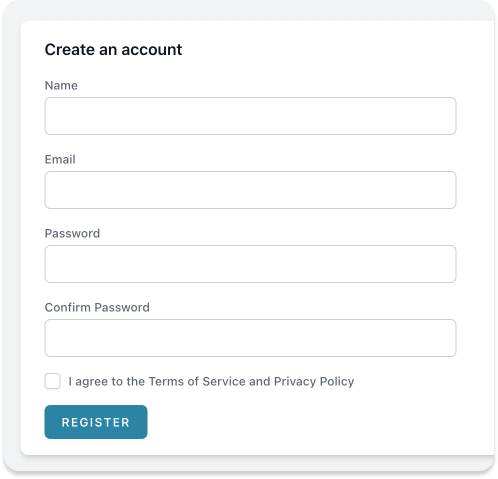
First, you'll need a Locale account. Creating your Locale account is a straightforward process. Just fill the 1-step registration form and name your Workspace. Your free account will be ready.
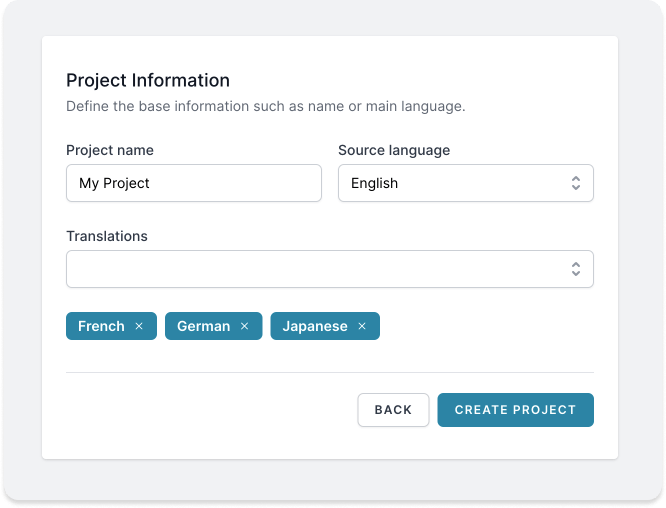
Now, create a new project and give it a name. Define the source locale and add all the languages you want to translate the project to.
2. Install the Laravel package into your application
The final step is to connect your application with your newly created project within Locale in order to sync the translations.
- To get started, require our free package in your composer.json.
composer require uselocale/locale
Don't worry, the package code is public and we do not have access to your project's source code. The only purpose of this package is to read the languages folder in order to interact with our internal API and synchronize the translations file.
- Next, add the project's API token to your .env file in the root folder of your project.
LOCALE_API_TOKEN=your_api_token_here
- Also, add a new entry in your services.php file.
'locale' => [
    'key' => env('LOCALE_API_TOKEN')
],
- And finally, link both parts using the setup command.
php artisan locale:setup
Once this is done, the current page should automatically redirect you to a lisiting of all your projects.
3. Translate keys with the Locale editor
It is time to go to your dashboard and start translating your project. Just find it in your dashboard, click the "View" button and you will be redirected to the translation panel.
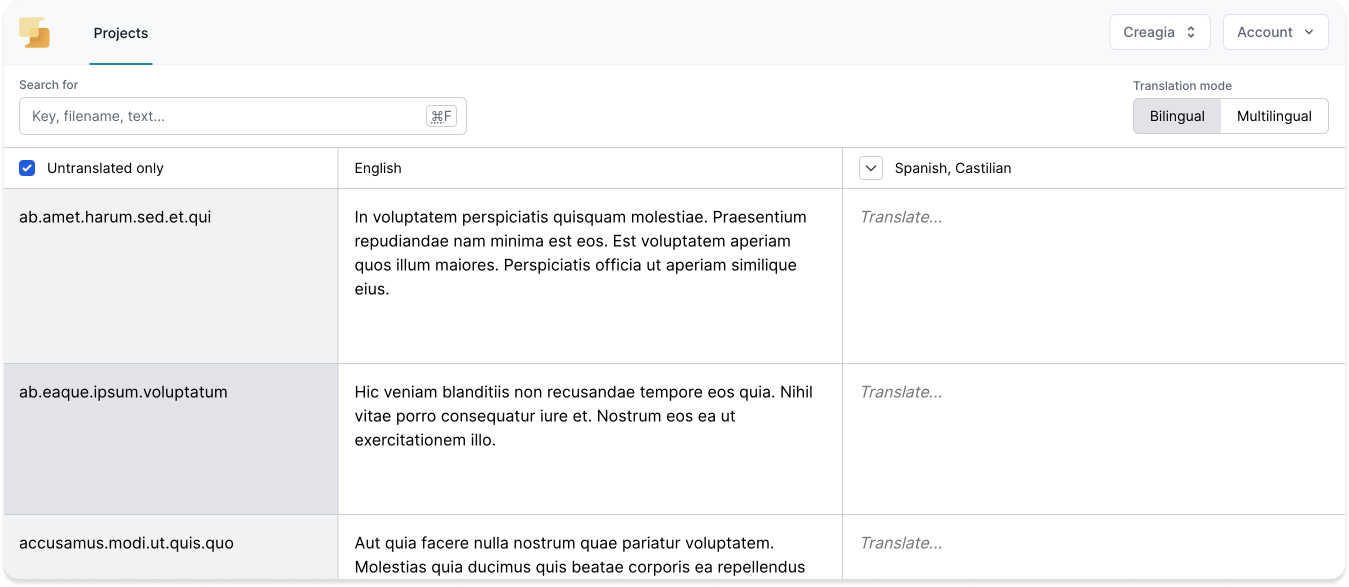
There, you can choose either the bilingual or multilingual translation modes.
With the bilingual translation mode you can get a detailed view source - translation for the desired language. On the other hand, using the mulingual translation mode you can quickly translate a key to all the project's target locales.
Add your translations and then click save or hit Ctrl + S in Windows or Command + S if you are using Mac.
4. Update your application with the new translations
Once the translations have been saved, sync your project with the latest changes using a simple terminal command:
php artisan locale:sync
The command is going to download and apply the new translations in your files inside the lang folder.
The translations are now available to be used in your project. Use any of the available methods in a Laravel project in order to retrieve translations.
// Using helper function
{{ __('file.key') }}

// Using the facade
{{ Lang::get('file.key') }}

// Using Blade directives
@lang('file.key')
Are you a visual learner?
If you got lost at some point or just prefer to watch the process with your own eyes, we have recorded a step-by-step video showing how easy it is to get started with Locale.
The importance of localization
In the current digital and global world, localizing your projects to multiple languages could greatly increase the success of your company. If you want to know more on how to localize your project to other countries and regions, take a look at the article "The importance of localization for your business" we wrote about the subject.
Early bird plan available!
🎁 Get started now and unlock an exclusive, grandfathered plan for early adopters.
]]>If you're offering any goods, services, or solutions to this global marketplace, your business must have the tools that enable it to make a difference anywhere. And it must be willing to offer unique and customized experiences to customers worldwide.
How can these goals be achieved? One approach is localization. If you're wondering what localization is, you've come to the right place. Read on to learn more and find out.
What is Localization?
Is "localization" just a somewhat pretentious word for "translation"? No, Localization is a comprehensive process of adapting content, products, and services to the needs of specific local markets. Localization is much more than translating texts. The translation is about transferring a text into another language while preserving its meaning.
Localization, on the other hand, encompasses much more. Localization also includes, for example, adjusting images or colors, formatting, user interfaces or designs, or even payment methods. Tools like laravel localization can help you manage translations smoothly and localize your business.
Localization of businesses increases the scope of the project through new promising markets. This is a necessary stage for companies focused on new clients in other countries, searching for foreign investors, and implementing marketing tools and content strategies.
Localization is a high-quality translation and adaptation of materials that reveal the features and benefits of a new product. In this process, all the details are important, the accuracy in using terms and the modification of visual elements. This helps make the right impression on a potential consumer and encourages him to cooperate further.
What Budget To Focus On When Localizing Your Business
The localization service in a simplified form includes translation, proofreading, editing of the text, and its adaptation to a foreign consumer. Business localization costs largely depend on the type of contractor chosen.
For business owners, there are several options:
- make machine translation of the text;
- assign a task to a staff member;
- hire a freelancer;
- contact a translation company.
The cheapest way to translate a text is to use a translator app. In this case, you can do it on your own. However, it is worth remembering that automatic translation tools do not consider the context. Localse, as a Laravel translation management tool is one of the best options for your business localization needs.
Why Is Localization So Important?
To become and remain relevant as a brand worldwide, you must communicate effectively with your target group. As you prepare your business to go global, localization will play a critical role in its success. Here are five benefits you can reap by making localization part of your business strategy.
Localization Makes It Easier For You To Access New Markets
When you enter the global market with your company, you can encounter various obstacles. Legal problems, logistical hurdles, and cultural and communicative challenges can delay your market entry.
While localization can't remove all of these barriers, it can undoubtedly help you overcome cultural barriers and avoid cultural faux pas that could adversely affect your brand's image. With a well-engineered localization strategy, your business can gain a foothold in a new market much faster and, if done right, avoid embarrassing translation errors. The laravel translation management tool can help you avoid such errors.
Localization Gives You A Competitive Edge
-
Local Competitors: If other companies are already established in a certain territory, it cannot be easy to raise your profile there. It is often much more accessible for companies already established locally than for "strangers" to gain the trust of local buyers. By localizing your products, you can gain competitive advantages.
-
Global Competitors: When your competitors don't localize their products and services, you have a distinct advantage in entering new markets.
Localization Increases Customer Satisfaction
By localizing content, you clearly show that you care about your customers. When you address your customers' needs in a way they understand and feel familiar with, they are more likely to choose your product. From user guides to payment methods to customer support, localizing every aspect of the customer journey makes it easier for customers to decide on your business.
Localization Increases Brand Loyalty
You gain customer trust when you offer a pleasant shopping experience. And trust is critical to brand loyalty. You earn their trust when you communicate with your customers in their native language and tailor your products and services. Satisfied customers will remain loyal to your brand and become real brand ambassadors as advocates for your products.
We have written a full article on Localization for business growth, don't miss it if you are interested in the topic.
Localization Increases Your Sales
Of course, a larger audience also means potential for more sales. You can expect increased sales when you effectively localize your products and services. Rely on a modern translation management system (TMS) like Locale to optimize your localization processes.
You can be sure that you can make optimal use of your translation and localization resources and that you can also profitably use technologies such as machine translation. Ultimately, this leads to a higher return on investment that will impress all stakeholders in your company.
If you're interested in getting a deeper understanding of the topic, we've put together a full article explaining why localization improves the sales of your business.
What's Next?
If your goal is to expand your business globally, localization as part of your business strategy can enable you to break down cultural barriers and enter new markets. But that's not all! Realizing that localization matters is only the first step.
You should consider the concrete implementation and find the right technology to implement your plans. To do this, you must also get the various stakeholders in your company on your side.
But don't worry: we have just the right tool to help with the localization of your business. Locale is one of the best options with a smooth interface to help you localize your business. With various features, you will enjoy enhanced workflow, improved communication, and faster results.
Give your startup a competitive advantage by signing up to the laravel localization tool right now!
]]>